Robbin L Marcus
For up-to-date Alexander class information, please click:
  • HOME
  • Music Teaching Resources
    • Workshops & Residencies
    • Kodaly Teacher Certification
    • Folk Music Links
  • Dance Resources
    • Contra/Square Dance Caller
    • Contra and English Dance Piano
    • "Reelplay" Dance Band
  • Health and Wellness
    • Alexander Technique >
      • Private Alexander Lessons
      • A.T. Class Information
      • A. T. Links
    • Reiki
  • Piano Lessons
    • Marcus Music Studio calendar and fees
    • Marcus Music Studio piano contract
  • Upcoming Workshops
  • Blog

Day 11 - The Big C

2/11/2019

 
Recently, I’ve been thinking a lot about cancer and the havoc it wreaks in people’s lives. Cancer has had its way with me more times than I can count. Starting at the age of 13, with my mother’s first bout with cancer of the throat, I’ve watched and assisted way too many people down the road of discovery, treatment (sometimes successful, sometimes not) and whatever the outcome may be – a return to health, or the finality of death. So many friends are dealing with cancers of their own or their family members. I read and weep over Caring Bridge sites. Cancer has claimed my mother, my father, my beloved grandfather, Dave’s sister, Dave’s ex-wife, and now my ex-husband is in the end stages of glioblastoma. I sit here today as Dave undergoes a prostate biopsy. Really, it’s all just too much. 
 
I’ve been reflecting all day about whether or not I have any habitual responses to hearing about yet another cancer diagnosis. There’s anger, and sadness, and ultimately resignation – the normal stages of processing. I realized that cancer no longer scares me. It just pisses me off, and then I get realistic about odds and outcomes and go into caregiver mode. (That’s a big deal, as the fear around cancer used to overwhelm me.) Physically, I realize that I tend to store a lot of the stress and tension in various parts of my body when I’m worrying about other people’s health. Right now, my shoulders are locked up, and I’ve got a wicked case of indigestion. On the other hand, I’m trying to write this in a doctor’s waiting room with HGTV blaring in one ear and James Taylor going to Carolina in the other. Excuse me a minute while I close my eyes, breathe, and see if I can let some of that go. Ah. That’s a little better.
 
Eighteen years ago, in 2001, I know that my reactions to loss, cancer, and death were far more heightened than they are now. My divorce was final in 2003, although my husband and I had separated right before 9/11. Once we decided to divorce, we made plans to sell our last house we’d owned together. It was too big for either of us to afford alone, and as a 100 year old house, it had looming expensive repairs that we knew that neither of us could take on. So with great sadness, we put it on the market. Buying that house had been a great move for us, as the value had doubled in the 3 years we owned it. Because of that investment return, we could each afford a smaller home once it sold. 
 
My mother’s father, my Pops, was an incredibly important person in my life. After my mother died, he became the living substitute for her in my life. We adored each other. I confided in him, and he in me. When my grandmother passed away unexpectedly in 1992, we drew even closer. He had been a bank vice president, and he served as my personal investment advisor for years. In 2000, one of the last things we did as an intact family was to throw him a surprise party for his 90thbirthday. He’d never had a surprise party before, and he was astonished and delighted. We joked that it was lucky that the surprise didn’t kill him!
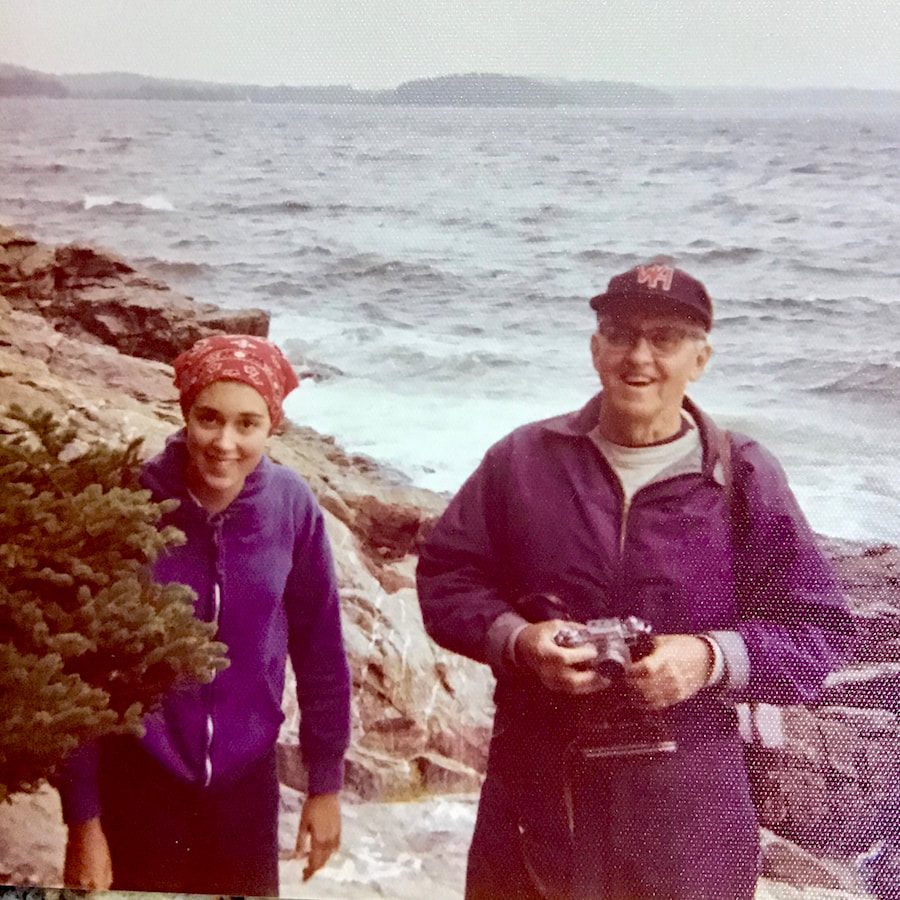
Pops and I on a happy vacation day in Maine.
Picture
Shortly thereafter, he started to deteriorate mentally and physically. He became increasingly forgetful. He went up on the roof of his rancher to clean out the gutters, and slipped off and broke his ankle. It’s a miracle that was all he broke. After that experience, he began to slip even more into a form of old-age dementia. I was worried about him all the time – he was still in New York, my dad and stepmother were in North Carolina. It fell to me, in Maryland, to drive up and check on him. He had great neighbors who fed and cared for him, but I knew he wasn’t eating or drinking enough water. So on the weekends when I wasn’t driving to Philly for Alexander school, I was driving Anne to NY to go visit Pops. I took over as Executor to pay his bills, and suddenly, after years of him advising me financially, our roles were reversed. It was strange and very painful. I felt completely alone in this huge adjustment period of my life. 
 
I started asking my grandfather to consider moving in with us. I thought that if we sold his house, between the income from both house sales we could get a house in Baltimore with an in-law apartment for him. He refused, citing getting lost in Baltimore in 1937 as a reason he never wanted to move there. So, I bought half a duplex for Anne and I, which was what I could afford. The traveling continued until he was finally hospitalized for dehydration and kidney failure. He couldn’t go home afterward, so he went to rehab for several weeks. Finally, the crisis point had arrived. A family meeting with my dad, stepmother, grandfather and I resulted in his deciding to move in with my dad in North Carolina. I was relieved that he wouldn’t be alone in New York anymore, but very sad that he was not moving in with us.
 
I continued on doing all that needed to be done to keep his house afloat and his bills paid, in addition to rehabbing my own house, dealing with a non-driving teenager and all that good and bad that entailed, working my full-time job and feeling oh-so-alone. An old boyfriend from college resurfaced and began to help me out around my house with repairs. I was thankful to have someone to be with on occasion, to talk to and to lean on.  I remember this time as a period of never stopping, never having time for myself other than my weeks at Alexander School.
 
If you’d asked me at that time what the most difficult thing was in my life, I would have told you “loss was my issue.” Even hearing the word Loss was enough to make me cry. I knew my grandfather would not live forever. I honestly didn’t know how I was going to deal with his passing. Already he was slipping away from me mentally, descending into paranoia and fear of losing his mind. It was awful. And then, finally, came the colon cancer diagnosis. We didn’t tell him for a long time, because we knew – as soon as we said the word cancer, he’d be gone. There was nothing he feared more. At ninety-two we were not going to be treating this disease. Finally, after months of regular blood transfusions, he figured it out. He asked my stepmother point blank if he had cancer. What could she do, other than answer him with the truth? He was gone in 3 weeks.
 
It wasn’t as hard as I thought it might be. I realized that to a large extent, I’d already lost and mourned him months before he passed. I orchestrated a lovely memorial service, where the entire family gathered to celebrate a long life well lived. We could finally put his house on the market, and after weeks of cleaning out dumpsters full of unneeded stuff (a life lesson for me, Anne and my dad) we loaded up a trailer full of furniture and returned south. The days of traveling to New York were finally over.
Picture
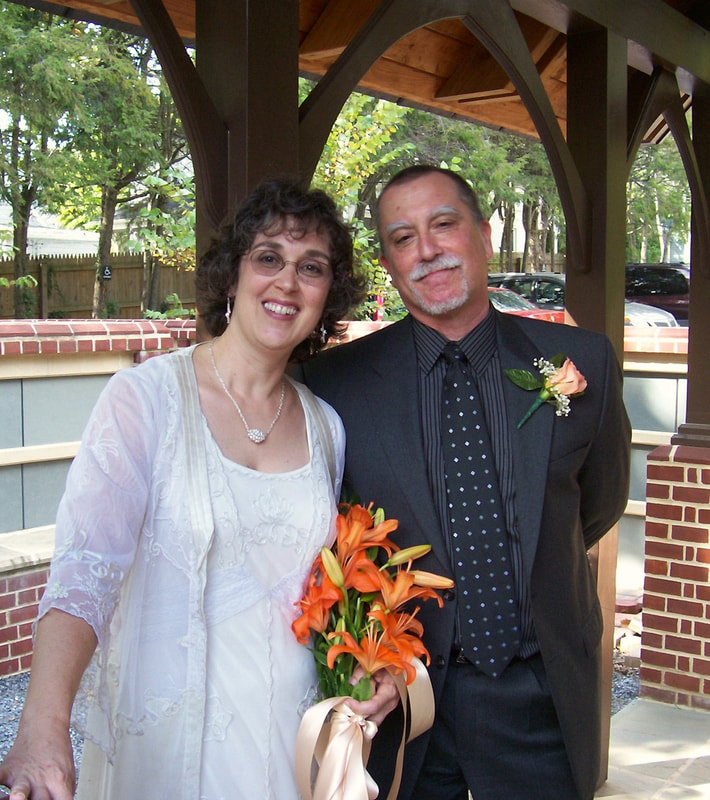
Dave and I on our wedding day in 2007.


​

​What losses have most impacted you in your life?

How did you deal with them?
When faced with transitions, do you realize that you have options?
At the end of that long year I met Dave Marcus. A multi-year courtship ensued, culminating with us getting married and my moving to Atlanta in 2007. That summer, before I moved, I was driving to the supermarket one morning while listening to NPR. The commentator was talking about loss. She listed 7 areas of loss that cause people to lose their center, to fall into depression. I sat in the car in the parking lot and burst into tears. There was my life. Death. Divorce. Cancer and other serious illnesses. Kids going off to college. Moving. Life transitions, even happy ones like a new marriage. Leaving a job. Well, well. At least I knew what was going on, and at least I had my Alexander Technique skills of awareness, pausing and choosing different ways of looking at things to fall back on. I knew how to restore myself physically as well as mentally. Exciting and positive times were ahead. I dried my eyes and went grocery shopping.
Picture
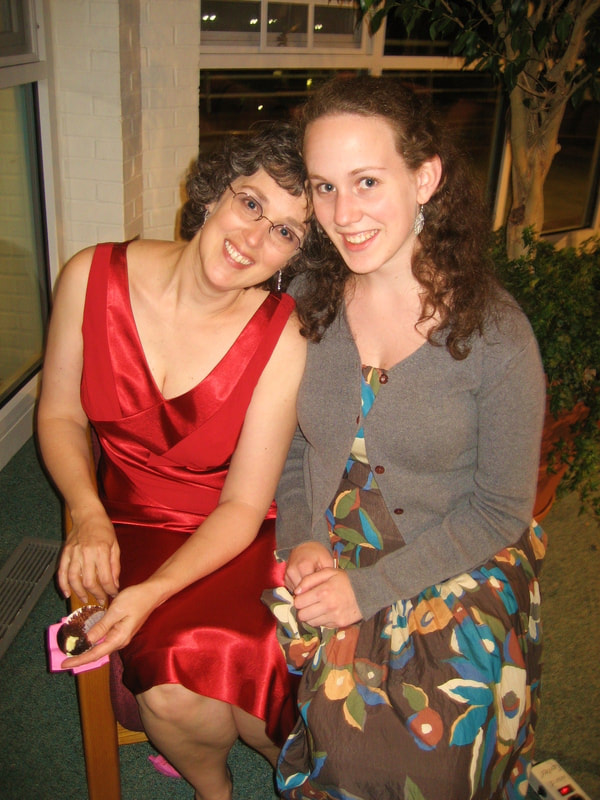
High School Senior Anne and I at my last Children's Choir concert.
Day 10 - Meet the Fixer

2/10/2019

 
“Did you get your English paper back today?” “Yes, Mom.” “Let me see it.” (pause) “A minus….that’s great – but what could you have done better?”
 
My mother was very proud of my academic abilities. Her side of the family were all brilliant people, and it was expected that she would be the first to graduate from college. Her sight started deteriorating during her freshman year until she was labeled “legally blind.” Sadly, in a world without the compensations for the blind that we take for granted today, she was unable to finish her schooling. This put a lot of pressure on me to be the first in my family to meet the college goal. There was never any doubt in my mind that I would do it.  I loved school, and I assumed the family mantle of being The One to do it gladly. By the time I left home for college, I was an expert in figuring out things for myself without asking for help, in putting a lot of pressure on myself to succeed, and in placing the expectations of others ahead of my own desires and needs.
 
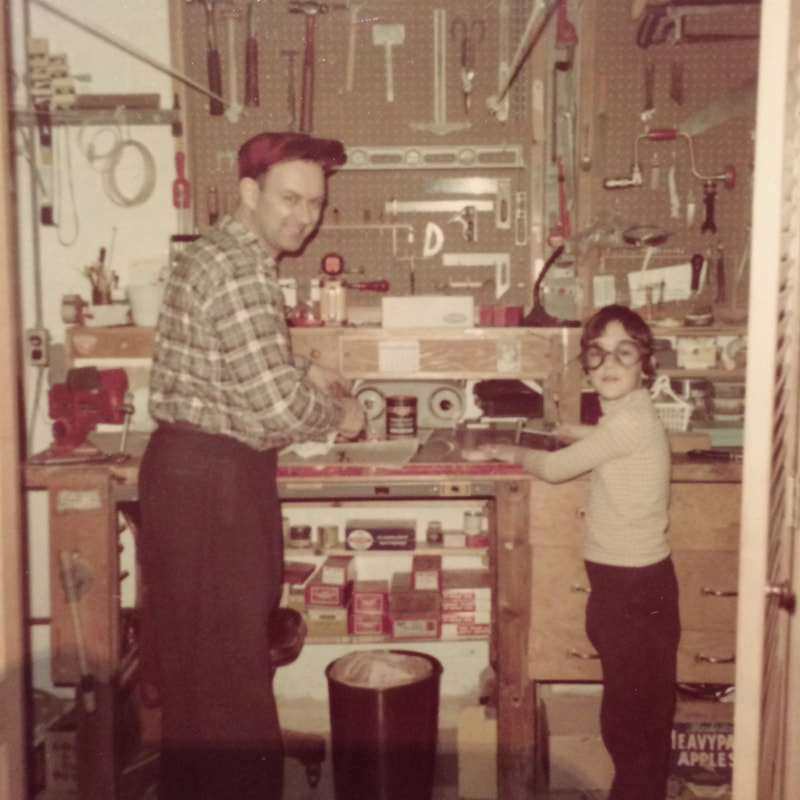
My father, on the other hand, was pretty laissez-faire about the whole academic thing. He was a champion problem-solver. He loved puzzles of all kinds, but especially ones you had to solve physically, like those little metal clumps of shapes that were all hooked together that you had to put into individual pieces. He also loved Rubik’s cube. He could pack the back of a car full to the brim with more than anyone ever thought would fit in there. He had the neatest workshop you have ever seen, with everything in its place all the time. An electrical engineer, my dad was highly valued for being a real out-of-the-box thinker, and he seldom went in a straight line from A to B. Over the years he did a lot of things for me that no one else could figure out – like rewiring an outdoor Christmas lights timer to turn on during the day instead of at night so I could use it to run a birdbath fountain. He built me a composter out of a 50 gallon barrel. He taught me to think creatively, to problem solve, to love jigsaw puzzles and word scrambles. 
Dad and I solving the world's problems in his workshop.
Picture
With the gifts from both of my parents in hand, much of my adult life has been spent teaching other people to think creatively about highly academic things, like folk-song analysis, research and music theory. The various injuries I’ve had due to being hypermobile encouraged me to study more about the body and to learn the kind of anatomy that helps me to understand how the body works and what our various muscles are for. I’m naturally curious, like my dad, and I still want to be very, very good at whatever I learn (thanks, Mom.) 
 
Underlying all of that, of course, is a level of fear that no matter how “good” I am, I will never be “good enough.” The problem solving gifts take the edge off of that, but underneath it all is always a worry that I’m really not as good as people think I am. Imposter Syndrome resonates for me. For much of my life, that led me to just push myself harder to be even better, even smarter. It’s a lot easier to get good grades (or to fix other people’s problems and wrong answers) than to fix yourself and come to terms with those fears. 
 
Part of the “shadow side” of always wondering if you’re good enough is the imaginary yardstick by which others can be measured and judged. After all, if you’re judging yourself, you have to have something to measure against. Living in a world of “right” and “wrong” is something we’re all too familiar with these days, and it certainly is easy to go there. Why choose grey when black or white is so clear? 
 
So why would a person like me be attracted to the Alexander Technique – something that encourages you to be in the moment, to suspend judgment, to listen, to perceive? From my personal experience, it’s exhausting to have to be “right,” to be “better than.” When I got off the Yes Train, I decided I wanted to get off the Right/Wrong Train, too.
 
Perhaps the most difficult part of becoming an Alexander Technique teacher for me was letting
go of this particular habitual thinking pattern and the immediate need to decisively problem solve. I remember teaching a lesson early on, in my practice teaching days, when a student walked in literally limping from a very clear problem with her right hip. She hadn’t said a word, and I had already formulated in my mind how I was going to address this problem, ideas to “fix” it, where I was going to put my hands, etc., etc.  She sat down, and I said “What brings you here today?” She replied, “My left shoulder is really hurting.” Oh. Wow. Oops. That was unexpected. What a great Alexander lesson for ME.  In the overall scheme of things, and with the hindsight of 15 years of teaching, it is entirely possible that her shoulder was hurting because she was having a problem with her hip. But in that moment, at that time, it was my job to simply listen and ask good questions. It’s not my job to have the answers – that honor belongs to each student alone. Believe me when I tell you that that was both what attracted me to teaching the Technique and scared me half to death. I really didn’t know if I could simply listen without coming up with solutions for people, but I wanted to learn how.

 
Over time I have come to understand that all of life – our habits, our ways of holding ourselves physically, our opinions, everything – is on a continuum. There are many continuums, and it helps me to get away from ideas of “right” and “wrong” to look at life this way. If you’re familiar with the Meyers Briggs test, you know that there are four continuums contained within it that help us to understand the ways we each function best in the world. The one I’m working on illustrating here is the Judgement/Perceiving (J/P) continuum.  Here’s a quote from the Meyers Briggs Website which to me, sums it up:
 
“Everyone takes in information some of the time. Everyone makes decisions some of the time. However, when it comes to dealing with the outer world, people who tend to focus on making decisions have a preference for Judging because they tend to like things decided. People who tend to focus on taking in information prefer Perceiving because they stay open to a final decision in order to get more information.”
 
If you click the link above, you’ll see that the Meyers Briggs descriptions of Perceiving and Judging are a bit different that the definitions we usually assign those words. The checklists there will help you see pretty quickly in which direction of that continuum you naturally align yourself. You’ll have to take the test to see exactly where you fall.
 
When I first started Alexander Technique studies, I was 98% J. My most recent round of the Meyers Briggs shows me at about 54% J, which means my Perceiving ability has shifted and increased by 44% over the last 15 years. I find that academically interesting and, thankfully, out of my typical and habitual box.
 
Having a judging mother and a perceiving father made me what I am.
I still make to-do lists. I still like to make decisions. Occasionally I really need to be “right.” (Ask my husband!) 
My Alexander Work has helped me let go of the shadow side of judging, and allowed me to experience perceiving in an open, receptive way with my students. I have worked hard on not focusing so much on the goal that I miss new information along the way. 
 
What “gifts” did you inherit from your parents?
Are you a judger, or a perceiver?
What habits of thinking serve you well? 
Are there habitual thinking patterns you’d like to let go of at this point in your life?


Day 9 - Hypermobility and Me, A Love Story

2/7/2019

 
From the time I was a little girl I had always been called flexible. I remember spending hours on the floor of my room, sitting between my knees, feet splayed out to the side, working on one craft project or another. I was never very good at sports, accurate throwing and catching eluded me, running was hard, but when I finally found ballet, suddenly I was “home.”
 
In ballet class, I delighted at how far I could stretch. Between classes my teacher used to do this sort of “Egyptian” movement with an ash tray in his hand – up, down, around – turning his arm in crazy directions and never spilling a drop of the overflowing butts and ashes. We begged him to teach us the trick, and I was the only one who could consistently turn my shoulder and contort my arm like that. For a long while, I could pick up my foot and rotate my hip in such a way as to touch my little toe to my ear. It was fun. It was weird. It got me attention. In my thirties I finally learned there was a name for what I could do. I was Hypermobile.

Picture
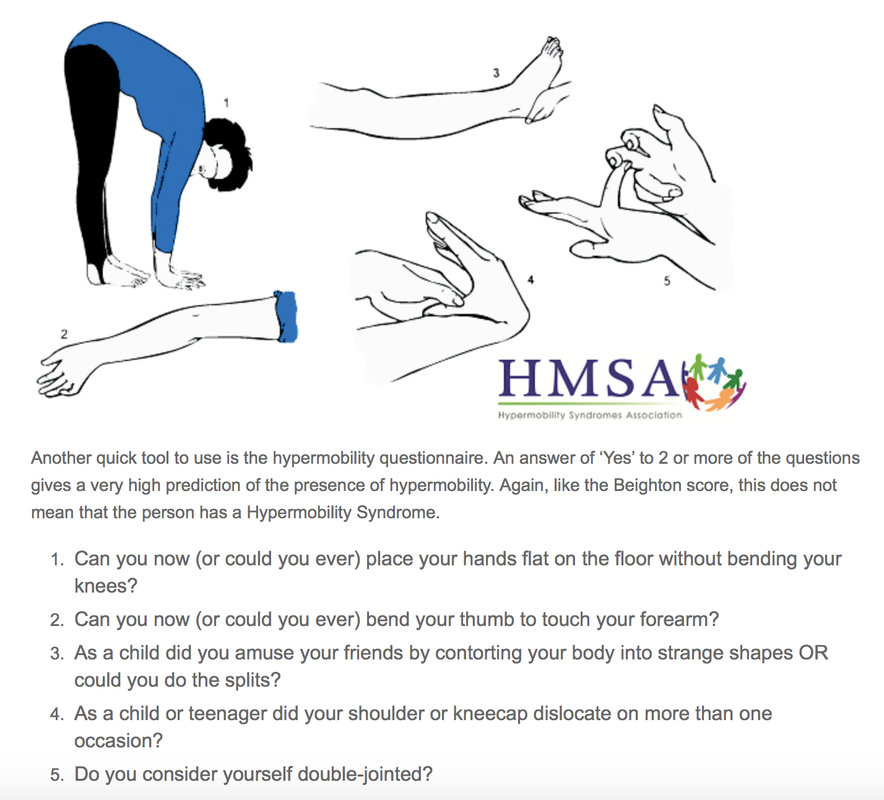
Hypermobility Syndrome is not written about much in the United States. It’s only become a better-known issue in the UK in the last ten years or so. When someone is hypermobile, like me, one can contort the body into places it shouldn’t ordinarily go and bend joints “backwards” beyond the normal range of motion. (Think Cirque du Soleil performers.) This happens due to a collagen disorder in the body. Collagen makes our skin firm and it also supports the strength of our ligaments and digestive tissues. Hypermobile people can dislocate shoulders, knees, hips, fingers, you name it, with ease. We also often have digestive problems, and this area of study linking Hypermobility Syndrome to leaky gut, fibromyalgia and other well-known diseases of the immune system is just gaining traction in Europe.*
 
I dislocated my right shoulder for the first time at 17. My dad and I were driving out to Indiana for my freshman year of college. We stayed overnight in a hotel with a pool. I dove in, and under the water my shoulder felt a little funny. I came up and it looked a bit weird, too. “You ok?” my (also Hypermobile) dad asked. “Yeah, my shoulder feels weird.” “Well, just bang on it and see if it goes back to normal. That happens to me sometimes.” I did, and it did, and that was that.
 
Only it wasn’t. In the ensuing years, it started to happen more and more often. It wasn’t very painful, just odd, but slowly over time I started limiting my activities as my understanding of what I had to do to throw it out grew. Tennis? No overhead smashes. Swing dance? Left arm turns only. Stuff in a high cabinet?  Someone else get it, please. I began a long, slow series of protective behavior that I physically needed to learn to cope with this. 
 
Finally, one day in my late twenties, it happened at work. I stretched at my desk and it went out. I couldn’t get it back in, so I went up to the school nurse and asked her to pop it in for me. She freaked out and called the paramedics. That was the beginning of the end. It was out for over an hour and the pain became excruciating. Somewhere in the next decade surgery was strongly suggested. Six weeks in a sling with a toddler in my world wasn’t happening anytime soon, so I put it off again and again, until it started going out in my sleep. 
 
I had some control over what I did to protect it while I was awake, but asleep? No hope for that. So finally, I made the time to have reconstructive shoulder surgery – about 20 years after that dive into the pool.
 
Twenty years of habitual protection did not want to leave, even when the PT pronounced me back at 89% of my original mobility. I was extremely fearful of trusting my shoulder again. I now had freedom and permission to go back to tennis, swing dance, yoga, all those activities I had limited, but I was scared half to death.
 
Thankfully, at this point I had started studying Alexander Technique. I learned first hand that one of the biggest benefits of AT is that it can teach you to lovingly let go of habits that no longer serve you. I learned to trust my body, to let go of gripping my arm to my side, to raise it up overhead without fear. I learned to appreciate my habit, to thank it lovingly for protecting me, and to let it go. 
 
Without the pause, the letting go of the fear, and the choosing a new direction to move forward, I’d probably still be protecting that arm.
 
In my teaching practice, I see this so often. People get new joints and they are afraid to trust using them. I see folks with new hips and knees still limping like they did before surgery, because they haven’t learned to trust their new “bionic” selves. Some folks never will. It’s a huge internal conflict (with a lot of fear involved) to let go of protecting ourselves around physical trauma. The psychophysical tools of Alexander Technique can help.
 
Do you have old injuries or physical trauma?
Do you still protect yourself from repeating that trauma?
What habits can you thank for showing up, and then let go of today?

 
*If you’d like to read more about Hypermobility studies in the UK,
​
click here for a link to the article on the efficacy of AT and Hypermobility.


Day 8 - Learning to Ask for Help

2/6/2019

 
“Robbin, how are you doing with everything that’s going on right now? Are you ok?” “Yeah, I’m fine, I guess,” I answered. “There’s really nothing I can’t handle.”
 
If I didn’t say those words aloud, I certainly thought them. A lot. 
 
I grew up in a small town in New York state, about 40 miles from New York City. I had a pretty idyllic ‘60s childhood – we wandered and roamed through neighborhoods, woods and fields on foot and on bike, getting back home only in time for meals. I was the only child of two only children, and as such, I learned very well the lesson to be independent and to do my best to take care of myself out in the world. I envied my friends who had big brothers to protect them and fight battles for them. My mother was willing to go to bat for me when needed, but when others made fun of me for getting my mother involved, I quickly learned the lesson that if I couldn’t handle it, it was best to just keep it to myself and work it out as best as I could. 
 
Before her marriage to my dad, my mother lost her central vision and was declared legally blind, although she did have limited peripheral vision. For me, growing up with a partially sighted mother was just "normal." My mother had books on records, and later on cassette tapes, that she listened to. She was amazingly creative and sewed beautiful clothing for all of us, even with her limited sight. She was a fabulous cook and baker. What was hard was that there was never anyone to take us shopping, and my mother didn't get out socially very much, which I know she missed. My dad was a pretty big introvert, and it was hard in the suburbs for my mom to have friends when she couldn't drive to meet people out somewhere. 
 
My mother absolutely hated asking her few good neighborhood friends for help. She would agonize over making a phone call to her best friend to ask her to take her somewhere. She was afraid that since she couldn't reciprocate, she would “wear out” their friendship. Over the years, my mother told me repeatedly that you couldn't count on other people for anything and that you needed to be independent (which of course she wasn't able to be herself) in order to make your way in the world. If you were lucky, she said, you could count your true friends on one hand.
 
As a child, I observed and learned that lesson all too well. It was best not to owe anyone anything, to do it all myself, and above all, not to ask for help unless I really, really needed it. And then, it was better if someone just saw that I needed help and jumped in to do it with me. That was nice.  So I created a habitual, almost life-long response to do everything for myself, by myself. I had a lot of friends, but I seldom let them in to know what I was feeling, or what I needed.
 
Clearly, this was a recipe for personal disaster. No one in this world is meant to go it alone, and we all need to learn to ask for help at one point or another. 
 
At the lowest point in my life, I had not yet learned this lesson.
 
I talked some on Day 6 about Supermom syndrome, and at this point I was in the thick of that. Driving my daughter to activities every day after school, helping her with what she needed, doing lesson planning for my full-time plus job, traveling away from home for weeks at a time to guest-teach at universities, doing workshops, calling contra dances – when I look back at calendars from that time, I have no idea how I did it all. I never stopped, and I slept little and fitfully. I was not taking care of myself, instead pouring all of my energies out into others without replenishment or nourishment for me. Self-care was not yet in my vocabulary – I didn’t think I had the time.
 
My marriage continued to be difficult. After years of therapy, my first husband and I finally got to the point where we needed to try a separation. After a while living apart, we started “therapeutic dating” in the hopes of getting our marriage back on track. Living alone in our house with my daughter Anne was pleasant. Life got lighter and easier, but my body finally called it quits and completely failed me. I developed pneumonia, and I was home sick for over a month. I couldn’t shake the fever enough to go back to work. Finally, one day the school called and told me they absolutely had to have me there to direct a musical number in the school play. I told them I’d come in and sleep in the back of the auditorium until they needed me, do my thing and then go home. They woke me, I started down the uneven aisle steps, and promptly fell and broke my right ankle.  When I got home from urgent care, I called my husband and asked him for help to drive our daughter to school and other places for a month or so. After a moment of silence that seemed to go for eternity, he said, “I want a divorce.” The room started spinning. I was shaken to my core. I had asked him for help, and he refused.
 
Once I got over the shock, I started wondering what I was going to do to make all of this work. I simply couldn’t take care of myself, or Anne, or work, or do anything other than lie on the sofa and let my body get better.  Finally, finally, I had to ask for help from people outside my own family. And boy, did I have others in my life who wanted to help me. What a surprise! Dinner started appearing from church friends. Parents in the area rallied and worked out a carpool schedule to get Anne to school. Women from my therapy group came and sat with me and called me every day to see how I was doing. Suddenly there was a hugely abundant world out there that I hadn’t even realized existed. All of these people WANTED to help me. Me. By asking for help, I finally understood that I was worthy of receiving it. 
 
The following fall, I started my Alexander Technique teacher training. At the school I attended, the entire first year is focused on self-development, which was perfect for me at that time in my life. I decided that the best thing I could do was to approach divorcing my husband from the place of abundance I had recently discovered in the rest of my world, treating him with kindness in the process. For two people who had treated one another with scarcity throughout our entire marriage, this was a radical departure. And for me, it felt good.
 
Like shedding any other unneeded habit, it took me a while to learn to ask people for what I needed on a regular basis. My ingrained response is still to say “Nothing” when my wonderful second husband asks me if I need anything.  So now, I pause, I check in with myself – maybe I’d actually like a glass of water?  - and I let him do nice things for me. It makes both of us feel good, and reciprocating is fun. The best way to create a new habit is positive reinforcement, after all.

Picture
I spend a lot of time working with people (particularly women) who are also struggling with this lesson. A self-care routine, be that Alexander Technique, a good massage every month, a night out with friends or a date with a partner, is crucial for our mental and physical health. Asking for help is a huge part of getting past the Supermom pattern. Enjoying the help received, and then giving back from a place of having been nourished yourself, is both healthy and joyful. To get there, we have to let go of behavioral patterns that keep us from thinking that this is not only ok, but necessary.  It’s like being on that airplane – you put your own oxygen mask on before helping others.
 
 
What is your relationship to asking for help from others?
Do you have a self-care routine?
What habitual responses could you eliminate from your vocabulary?

Day 7 - Monkey is Everything

2/5/2019

 
WARNING: This post contains Alexander Technique Jargon, the understanding of which could be hazardous to what you thought you knew about your health.
“So, if you just let go…. There, right there… you’ll be able to lower yourself the rest of the way down.” I stood up sharply, panicked. I hadn’t been down in a full squat in years, and I wasn’t about to hurt my knees past the point of no return trying to get there now. I knew that knee surgery was imminent to repair the damage to my cartilage from all those years of bicycling incorrectly. It hurt to bend my knees past a certain point, and fear absolutely took me over. Even in an Alexander workshop where I felt safe, this was scary stuff. My colleague beckoned over a senior teacher.
 
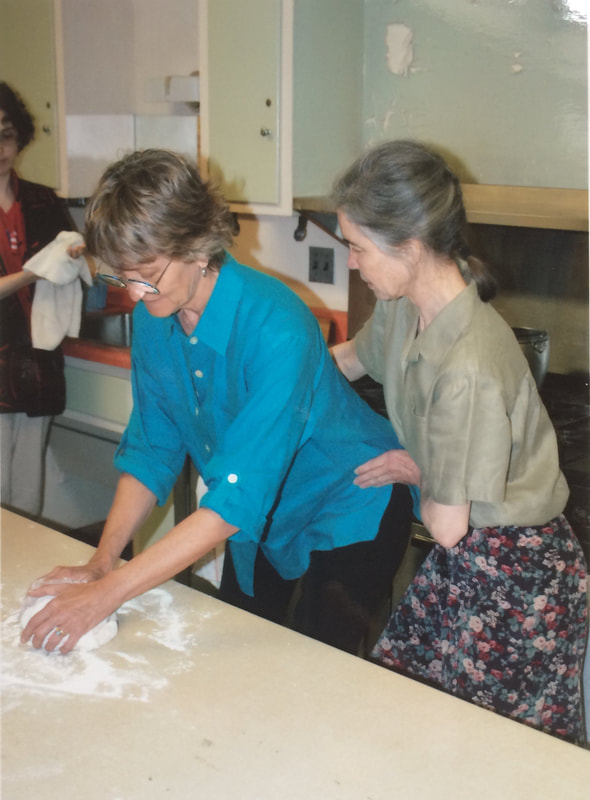
We were working in this class on something FM Alexander called “The Position of Mechanical Advantage.” It’s a good descriptor, but a terrible name. I understood it in my body in a particular way from years of playing tennis, where we just called it “Ready Position.” In this place, knees, hips and ankles are all free and flexed, allowing the body to fold gently at those large joints. From here, you can go anywhere – into athletic movement in any direction, down into a chair, or all the way to the floor in a squat. The first generation of Alexander Technique teachers nicknamed it “Monkey,” because in this place with joints flexed and arms relaxed and hanging, that’s kind of what we look like.
 
In the ensuing years, I’ve come to understand that the POMA is really involved in all human movement done well and with ease. I had a student once suggest that I paint the phrase “Monkey is everything” around the top of the walls of my studio. (I guess I say that a lot!)  It’s unloading the dryer, loading the dishwasher, lifting anything up off the floor, how we sit and how we stand. And back then I didn’t get it at all.
 
Martha came over to us and put her hands on my hips. (There’s a theme emerging here – look at my day 4 post on Tai Chi.) She said” You’re gripping awfully hard in your glutes. Could you please let that go?” I stood up again, baffled. I had let go. A lot. At least that’s what it felt like to me. Martha assured me kindly that actually, no, I was still gripping quite tightly.
Picture
Martha Hanson Fertman, director of the Philadelphia School for the Alexander Technique, working with my colleague Mary on making Monkey Bread.
​


FM Alexander writes frequently in his books of something he labeled “
faulty sensory appreciation.” I know you’re thinking, “What the heck is that?” Well, I was in the middle of it at this point in the story.  In my bodily experience, on the inside, I was convinced I’d let go. But on the outside, to the teachers, it was clear that I had not. Not only did I need to stop gripping my muscles, I also needed to stop hanging on to my habitual thinking about what felt “right” to me. It was getting in the way of my actually being able to make a change in my body. This is one of the most common experiences people have in studying the Alexander Technique. Your internal “normal” may really not be balanced, comfortable, or easy at all. You’re just so used to being that way that it’s normal to you. Your own kinesthetic sense has become unreliable, and it takes a teacher to help you get past the confusion.

​I really wanted to trust Martha and to learn how to squat again, despite my fears around it. So I listened. I thought. I metaphored a dam letting go in my mind. And under Martha’s gentle hands, suddenly my entire backside let go with what I can only describe as a “whoosh.” Fascia with cobwebs attached to it creakily let go, and suddenly, there I was, deep in a squat with exactly zero knee pain.

 
Our habits often arise to protect us from harm. This is a good thing. But often, they outlive their usefulness. We have to learn to let them go and trust ourselves again. That day, I was able to thank my gripping habit for showing up, and then let it go. It was a long process of vacillating between confusion and clarity until that habit finally disappeared for good. The taste of freedom I had that day made the process more than worth it.
 
 
Are you protecting some part of your body from injury?
Do you catch yourself gripping your backside when you’re tense or nervous?
When is the last time you went into a full squat comfortably?

Day 6 - The "Yes Train"

2/4/2019

 
The phone rang in New York. “Robbin, we’d like to offer you a job teaching music in Baltimore, MD. It’s a big job – formerly we had the job divided into one full and one part-time position, but we’d like to try combining all of that into one, and you’re the person we want to do it.  Will you come and work for us?” “Yes! Of course!” twenty-two year old me cried. How wonderful. A “real” teaching job. Only four hours from home in NY.  And with that, the “Yes Train” pulled out of the station, and started its way confidently down the track of my life.
Picture

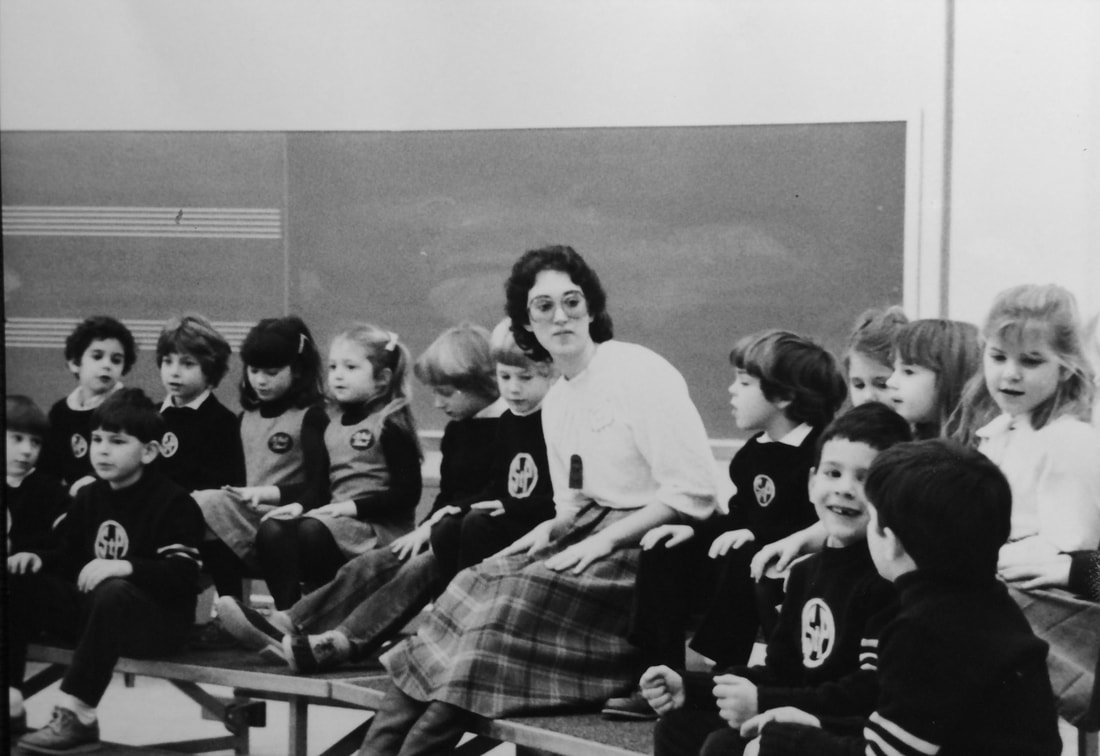
Me, giving a demonstration lesson with a first grade class at a teacher's workshop in the 1980s.
I was a people pleaser – I liked to make people in my life happy, and proud of me. I had learned that a good way to do that was simply to take on more, and continue to do everything well. So I did. I took a second job working for a children’s choir. I expanded my primary job to include a dulcimer ensemble and a school children’s choir. I started becoming known professionally, serving as president of my local Kodály music educators group and serving on the national board of the Organization of American Kodály educators for the first time a few years later. I started traveling to give music teacher workshops – first locally, then regionally, then nationally. 
 
I started contra dancing and met my first husband at a dance. We had a whirlwind courtship and were married in 1984.  My mother had her doubts about him – engaged six months after we met, married at a year – but I was head over heels in love and by now the “Yes Train” had picked up quite a good pace and I was definitely on board.
 
It wasn’t an easy marriage right from the start. We were both stubborn people, used to having our own way, and being “right” became important, very quickly. My husband and I were not generous with one another and there was a lot of fighting over things that could have been solved with a little kindness. Living this way very quickly became exhausting, especially since I seemed to be “wrong” a lot of the time. Heaven knew, though, my mother couldn’t have been “right” about this one, so I persevered on with him, always wanting it to be better than it was.
 
My mother was diagnosed with ovarian cancer shortly after my wedding. For two years, I traveled back and forth from Baltimore to NY to visit and care for her. Since my mom and my husband had an uneasy relationship, I often did this alone – leaving Friday after work and returning Sunday night. It was a dark and painful time in my life. It became harder to keep up with the demands of work and marriage. After her death, I was devastated. I had lost my rock, my confidant, my rudder, and the person who knew me better than anyone in the world. I was in the throes of terrible grief. My husband thought that since my mom and I had grieved so much together when she was alive that I should be able to move on afterward. I went through the motion of things day to day but the pain was pretty intense. I retreated inwardly since I had no one to talk with about it who understood what I had gone through. We were all so young! My friends had no idea what losing a parent was like.
 
In addition, I was not taking care of myself physically. We rode bikes seriously, sometimes a couple of hundred miles a week, and I was dancing, so I was in shape. But I constantly was throwing my back out. I was bending my head forward all day long – over pianos, small children, over bike bars, and increasingly over a computer keyboard. I was slumped over all the time, my head was as forward of my body as a turtle’s,I was in physical pain when I took the time to notice. We were vegetarians, and in the vogue of the time, we ate a high carb, low fat, lean protein diet. Every day I would get the shakes and have a hypoglycemic episode in the middle of the afternoon. Somehow, all of this was just “normal” in the throes of everything else I was dealing with. It got to the point where I was in constant pain, and I had no idea what to do to fix any of this.  The Chiropractic care I tried only went so far, and I finally ended up in a physical therapist’s office. 

Picture
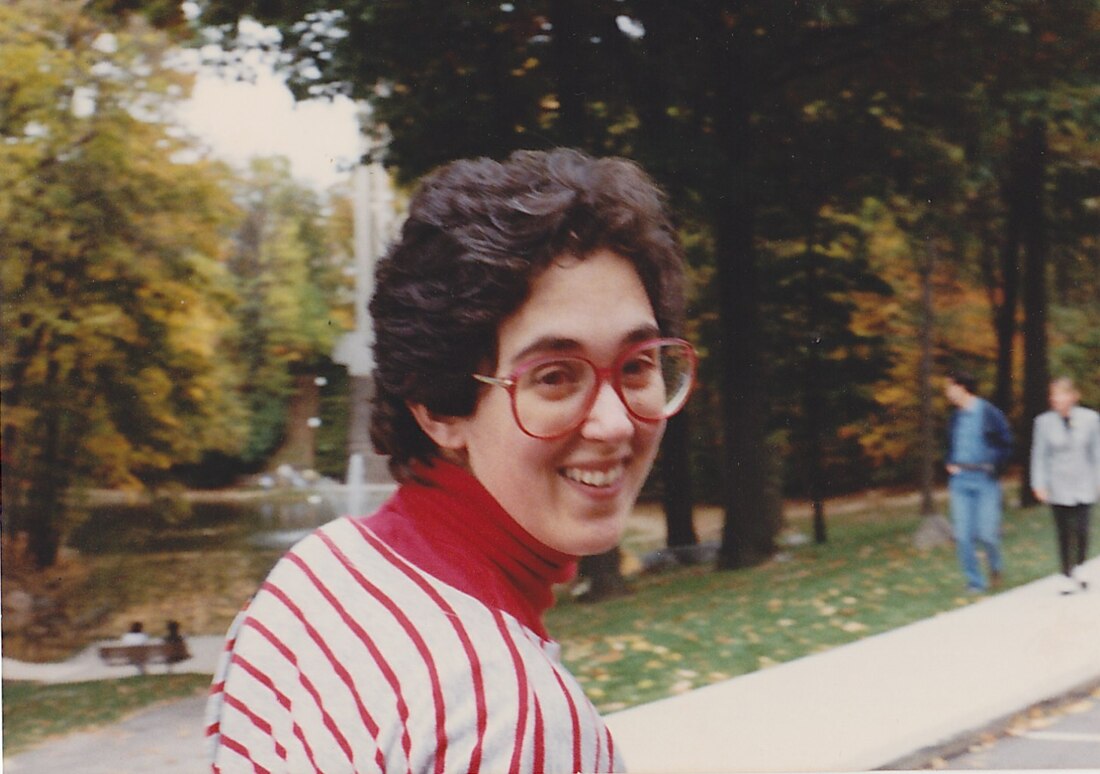
Me, prior to Alexander Technique in the early 90s. What do you see when you look at the relationship of my back, head and neck?
The physical therapist took me over to a wall in her office and asked me to stand with my back touching the wall and see if I could get my head back far enough to also touch the wall. I couldn’t – failing by about four inches. I had what today would be called “text neck”, from all the leaning over I was doing daily. She told me that if I didn’t do something about my posture, I’d be “bent over like a pretzel by the time I was 50.” This terrified me. 
 
Around the same time, a student’s parent was standing in my doorway at school one day. She said, “I’ve been watching you walk down the hall, and your head doesn’t have to get there before the rest of you.”  This parent led me to studying Alexander Technique, which literally saved my life. I began studying regularly with a teacher, and slowly realized that I had the option to make changes in the habits that were affecting all of my life, both physical and mental. I began to slow down, to learn to be in my body as well as in my head, to pay attention to what I was doing that was causing me physical pain every day. I had choices that I could make about how I was in the world. When I wanted to, I could pull the “Yes Train” into the station. Slowly, I learned to say “No.”
 
Alexander Technique (combined with the couples and individual counseling my husband and I were pursuing) helped me to begin to realize that until I started making changes in the way that I interacted with others, I would continue on a path of both mental and physical pain indefinitely. I saw a clear choice ahead of me – continue to try to make everyone else happy, or learn to be happy with myself.  My husband and I found a wonderful counselor who taught us to understand that “You can be right, or you can be in a relationship.”  We worked hard to try to learn together different ways of being with one another. Despite our best efforts, ultimately the marriage did end in divorce. At that time, I decided that I wanted to train as an Alexander Teacher as soon as I could get my life arranged to make it happen. That took a quite few years, and there’s a lot of story in-between.
 
Today, with the wisdom of hindsight, I watch many other women in middle age struggling with the same Supermom syndrome I found myself in during that time period. We can’t be all things to all people, but in the middle of all of that, it’s hard to figure out how to stop. This is where the Alexander Technique, with is pause in the moment, allows us to inhibit our habitual “yes” or “no” responses. We have a moment to see that we can make a different choice.
 
Alexander Technique teachers are not therapists, and I want to be clear that without working with talented cognitive therapists over the years, I don’t think I could have come out of the other side of this journey. But what the Alexander Technique gave to me that they did not was the connection back into my body. I learned to listen to my body, to pay better attention to its needs, to get out of my head and to come to a sense of psychophysical unity I could never have achieved by talk therapy alone.
 
I know now that we always have a choice to respond to any situation in a positive, affirming way. By choosing to respond in a positive way, we can move ourselves and the whole world forward.  My Alexander Training opened the door to living as a unified person – body, mind and spirit – whenever I choose to do so.
 
 
Are you on the “Yes Train” in your life? 
Do you know how to bring it into a station and get off?
What coping strategies do you use when you are doing too much?


February 01st, 2019

2/1/2019


Day 5 - Technology - An Alexander Lesson for Myself

2/1/2019

 
​I wake up early, my husband still gently snoring beside me. Almost furtively, I wonder “If I reach over and grab my iPad off the floor, will that wake him up?” I’m 59 years old. I didn’t grow up addicted to technology. In fact, I still know how to go for an evening without it in public. I have the will power to put it down, to go back to being present, to go cuddle with my spouse instead. Why this amazing pull to reach for a device as soon as I wake up?
Picture
This dilemma I’m facing in the morning is part of a much larger, more troubling cultural issue. I don’t think I can say anything here you won’t have read stated somewhere else on the far-reaching concerns of technology on psycho and social development. Yet, as someone who has worked with children her entire adult life, I do think there’s light to be shed on considering daily the impact for them.
 
Throughout my lifetime, there have been watershed moments in the growth of technology, media, and educational theory. I remember Sesame Street coming out in the 70s and the entire country being up in arms about shortening the attention spans of young children. I was just a teenager. I remember the disconnectedness of the short segments and how awful that initially felt. Would people get used to this? Well, they did. Remember the onset of 30 second commercials? How about 15? Video games were going to ruin us all. The smart phone has truly revolutionized the stream of information, immediate communication and how we all function in the world. Are we now harming babies by putting devices in their hands? I honestly can’t answer any of these questions, although I can certainly comment on the physical changes in people’s bodies that often bring people to me for Alexander Technique. Life continues to change and evolve, and we with it. 
 
Deep inside, though, I truly believe that we are short-changing our human-ness, our connectedness on a much deeper level than texting, by the constant interference of devices. As a teacher of many things, I believe that there is no greater joy than the light of a smile from a child who knows they have been reached out to by an adult. Children so want to connect with us. Their development depends on it. It also depends on us being present to them, rather than wrapped up in a device. Do adults deserve an escape from the world occasionally? Of course – but not at the expense of the children. How can children learn coping skills, negotiation, learning to live with disappointment, the art of losing gracefully, and what love is like if there is always a device distracting someone? Children need fights over territory in the back seat of the car, and singing silly songs for hours as a family on long road trips. They don’t need hours of screen time so that the car is quiet for the parents.

----------------------------------------------------------------------------------------
Oh, my.  I sit back and read what I just wrote. I realize I am struggling as I write this with a strong need to be judgmental. So, just now, I pause. I breathe. I allow my Alexander Technique skills to help me let go of the strong emotion that is gripping me here. I recognize that it is not for me to judge why people are using technology at any given time. My job is to be accepting, to meet people where they are, to ask questions that encourage people to examine their habitual behaviors. I listen. From this place of openness, not judgement, I learn many things. The world changes from a softer place, not from rigidity.
 
As I said in the beginning, I don’t have the answers. I do, however, have a lot of questions. If you’d like to explore some of your questions with me, come in for an Alexander lesson. The door is open.

 
What are some of your habits around technology?
What would a screen-free evening be like at your house?

​
Forward>>

    Robbin Marcus


    ​

    An occasional post from me, about stuff that interests me.

    2025 blog series:
    Cleaning Out the Old

    2024 blog selections: Resistance

    ​2023 blog series:
    Slow Forward 
    ​
    2020 blog series:
    1) Processing - Experience, Thought, Action
    ​2) Diving for Light - Shedding 
    light on a dark time
    ​

    2019 blog series: 
    Exploring the Power of Habit 

    All
    Alexander Technique
    COVID-19
    Mindfulness

    Archives

    March 2026
    February 2026
    March 2025
    February 2025
    April 2024
    March 2024
    March 2023
    February 2023
    April 2020
    March 2020
    February 2020
    January 2020
    December 2019
    November 2019
    October 2019
    May 2019
    April 2019
    March 2019
    February 2019
    January 2019
    November 2018
    August 2018

    RSS Feed

Proudly powered by Weebly